files
Josh Ghent (opens on the publisher’s site)
joshghent.com
-
/groundwork: a skill that makes any repo runnable from a fresh clone (opens on the publisher’s site)
Most repos only run on the machines of the few developers who set them up. /groundwork is an agent skill that finds the missing env files, databases and docs, then fixes them.
Josh Müller (opens on the publisher’s site)
joshmuller.ca
-
Two years ago, on February 6, 2023, two massive earthquakes hit the south eastern region of Türkiye and the north western region of Syria. These earthquakes ended up being responsible for over 60,000 deaths. As I wrote about and gave video updates about, I and a number of friends drove to the earthquake zone, and started providing aid within about 72 hours after the quakes hit. We continued to pro
-
The story of a workflow I developed to rapidly create alternating-language audio bible files in potentially 1,100+ languages.

Joshua Seigler (opens on the publisher’s site)
joshua.seigler.net
-
A script to apply dynamic compression and noise reduction to audio files
Joshua Morris (opens on the publisher’s site)
joshuamorris.info
-
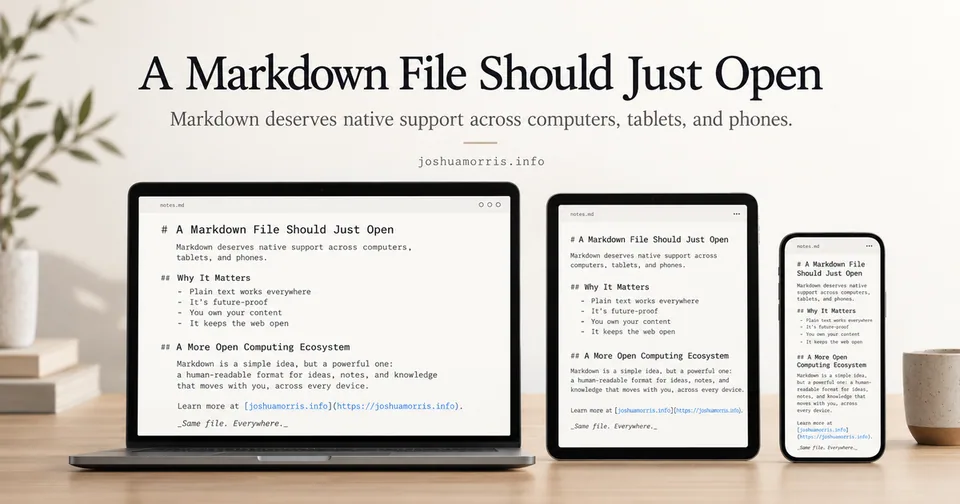
A Markdown file should open as a document on an ordinary computer or phone, without installing anything else.
-
Apple's Xcode 27.2 project format is JSON, smaller, and meant for people and coding agents to edit, with an open-source library instead of guessed parsers.
-
HTML Energy reminds us the web is still something a person can make— open a text file, write some HTML, and you have a website.
-
decayfmt is a Rust experiment that damages .tdcy and .idcy files on every open. It is a social contract, not cryptography—and a reminder that true ephemerality needs more than a file format.
-
George Michaelson’s history of the Berkeley sockets interface—how 4.2BSD in 1983 treated a network connection like a file, made networked programs straightforward to write, and quietly became the standard path for TCP/IP software, including modern protocols that still send data through sockets.
-
LetsSeal is an open-source tool that creates cryptographic seals so anyone can verify a file has not changed since it was published—arguing authenticity often matters more than secrecy, especially as software supply-chain attacks become more common.
-
Orchid Files documents a searchable network of GitHub repos shipping Trojan-infected ZIPs with near-identical READMEs—arguing list-by-list removals are not enough when thousands of clones stay findable through GitHub search.
-
Chris Coyier introduces CodePen 2.0’s largest rebuild—file systems, Blocks, one-click deploy, versions, and collaboration—arguing the original made it easy to try one small idea in public, and 2.0 lets that idea grow before you have to leave.
-
VaultSort Guardian uses on-device AI to find sensitive files sitting where they should not—arguing that narrow, local, read-only AI that discovers exposure without uploading or rewriting anything is the kind of utility worth wanting.
-
Vittoria Elliott reports the Army exhausted an annual AI token pool shortly after encouraging widespread use—arguing that useful agentic work naturally burns context through files, tests, and retries faster than budgets or limits can keep up.
-
LEGO Ideas’ new X-Files set is about 13.5¢ per piece versus roughly 10.8¢ for Yellow Submarine a decade ago—inflation and licensing aside, adult sets at $200–$1,000 make a childhood hobby feel like a luxury collectible market.
-
LEGO Ideas unveils The X-Files: The Truth Is Out There—a 1,478-piece set of Mulder’s basement office, a forest scene, and a hovering UFO, with eight minifigures and details worth finding room for at $199.99.