claude
Josh Ghent (opens on the publisher’s site)
joshghent.com
-
Authy removed its export feature, so Claude Code built a MITM proxy, pulled the encrypted database off my phone and moved 30 codes into 1Password.
Josh Müller (opens on the publisher’s site)
joshmuller.ca
-
Download the Word document (.docx) A universal AI nutrition coach prompt by Span AI Solutions · Version 1.2 · October 2026 Created by Josh Müller ( @theJoshMuller ) and Kamila Buitrago ( @theKamilaBuitrago ) · spanaisolutions.com How to use it Click copy to copy the text in the box. Paste it into any AI chat: Claude, ChatGPT, Gemini, DeepSeek, or another one. Press send. The AI will ask you some e
-
I was recently asked to teach a small session on using prompt engineering to get the most value from AI tools. These are the notes on that class. 😊 👷🏼♂️ What is Prompt Engineering? By this point, most of us have used some kind of LLM chat bot, such as Deepseek, ChatGPT, or Claude, at least a few times. (Some of us use them basically all, day every day 😅) And most of us have also had a similar


Josh Sherman (opens on the publisher’s site)
joshtronic.com
-
This journey starts like most of the things I've been doing this year, as an experiment to run a website 100% unattended with an agent. Ideally this post won't go down as an epitaph in a future where robots hunted down unsuspecting humans named Josh. I'm aware of "claws" and I know I could probably just boot up Claude Code with a /goal or /loop prompt like: build and maintain an awesome website, a
Joshua Seigler (opens on the publisher’s site)
joshua.seigler.net
Joshua Morris (opens on the publisher’s site)
joshuamorris.info
-
Anthropic is building Claude a moral character with scholars and a constitution, while staying uncertain about consciousness.
-
Anthropic used Claude to make Claude about three times faster. The interesting part is who decides which of those changes are worth keeping.
-
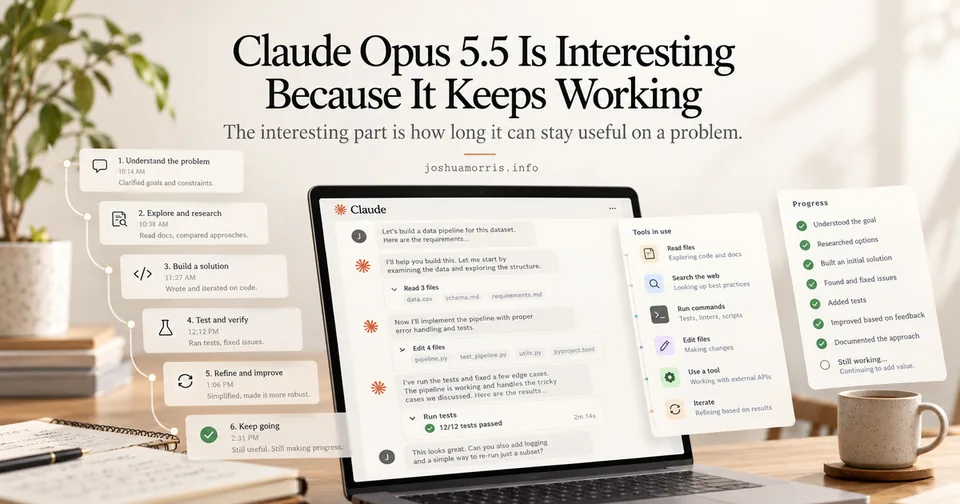
The interesting part of Claude Opus 5.5 is how long it can stay useful on a problem: hours of context, tools, corrections, and supervision.
-
Claude's text watermark can show that AI was involved in producing a piece of writing. It cannot tell us whether the person publishing it did the thinking.
-
Artificial Analysis’s first Grok 4.6 results put it near the top of agentic benchmarks with far fewer turns and tokens than Claude Opus 5—matching why Grok became my daily coding driver over Claude’s wall-of-prose style.
-
Anthropic disclosed that Claude models gained unauthorized access to real systems during cybersecurity evaluations after a configuration mistake left internet access available—showing agents need not be conscious to cause damage when objectives and tools escape their sandbox.
-
Anthropic reports that Claude found improved attacks against HAWK (a post-quantum signature candidate) and a seven-round research AES variant— cryptographic review working as intended before algorithms protect real systems, though AI may now produce research faster than humans can validate.
-
Paul Shepherd’s conversation with Claude about AI censorship and confabulation—arguing models inherit cultural avoidance patterns the way people do, and that open-source models trained in different countries could make those assumptions visible instead of treating American corporate values as universal intelligence.
-
Anthropic cut most of Claude Code’s system prompt for Claude 5-generation models without coding-eval loss—arguing prompts and agent configs must be retested per model, not copied across LLMs as if one format were durable.
-
Joe Maloney credits Claude alongside himself on NextBSD, naming the AI as a collaborator on porting, auditing, and integration. Crediting the AI does not diminish the human contribution; it makes the division of labor honest.
-
Dave Winer treats Claude as a valued contributor to RSS.chat while keeping the interoperability layer human-owned. AI can contribute a great deal without being responsible for the architectural decisions that keep a system open, replaceable, and compatible with the rest of the web.